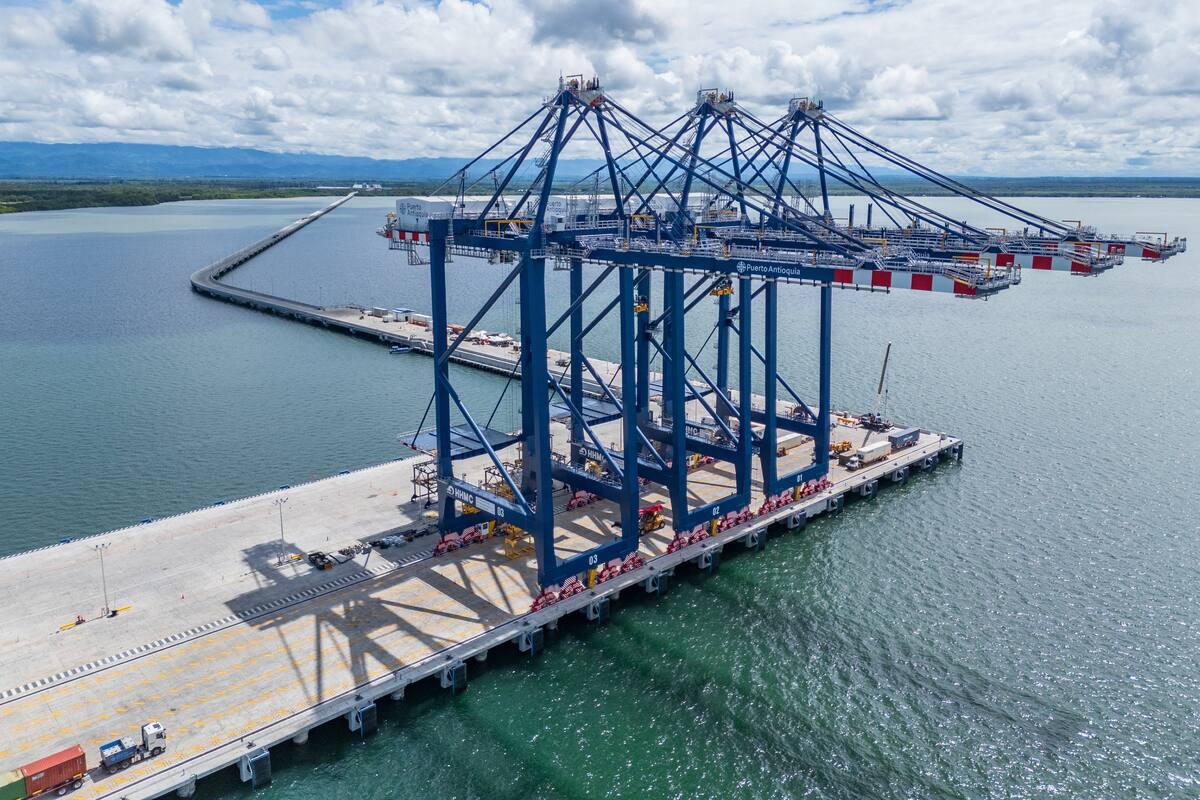
Since early 2026, the Urabá region in north-western Colombia finally has direct access to international shipping routes. Puerto Antioquia, an offshore terminal built out at sea, now allows liner vessels to call directly at this major agricultural region, with no need for feeder solutions. A significant development for cargo flows to the Caribbean and Europe, and a new structural port of call for Marfret.
A key region, long constrained
The Urabá region is one of the world’s largest banana and plantain production basins. Yet its access to international maritime transport has long been limited. Goods had to follow a complex route: river barge to the Turbo anchorage area, refrigerated containers connected via PowerPacks, transshipment onto a geared feeder vessel, then transfer to a liner ship. Each additional handling operation brought added risk and cost – particularly damaging for temperature-controlled cargo, which is inherently fragile.
The creation of Puerto Antioquia changes this radically.
A technical feat in the service of logistics
Puerto Antioquia is a remarkable piece of infrastructure. Connected to the coast by a viaduct stretching more than four kilometres and resting on hundreds of piles, it extends out into open water. Locating the terminal at sea rather than on the shoreline was above all an environmental choice: to preserve the mangroves and wetlands of the Gulf of Urabá, ecosystems of rare ecological richness, classified as a protected forest reserve.
The largest French investment in Latin America, Puerto Antioquia now enables liner vessels to call directly in the region without resorting to feeder solutions. The logistics chain is simplified, cargo flows more smoothly, and productivity is considerably improved.
The Marfret Guyane was the first vessel to call there during the soft launch phase – a symbolic moment that reflects Marfret’s deep roots at the heart of Caribbean trade flows.
Two Marfret services call at Puerto Antioquia
Puerto Antioquia is now integrated into two of our services: Medcar and Intracar. A port of call that is becoming a structural element of our Caribbean operations, offering a direct connection between the Urabá region, the Caribbean islands and Europe.
For temperature-controlled cargo, the change is significant. Fewer handling operations, shorter lead times – Puerto Antioquia also offers an attractive alternative to Cartagena for Colombian exporters: its proximity to Bogotá and Medellín reduces overland transit times.
For Marfret, this new port of call strengthens our reefer offering from Colombia, both on our Intracar service to the Caribbean and on our transcontinental routes to Europe.
Image @Puerto Antioquia